The journal
Master, worker, operator.
The figure is a single line drawn through a century of work, and every step on it was a good idea.
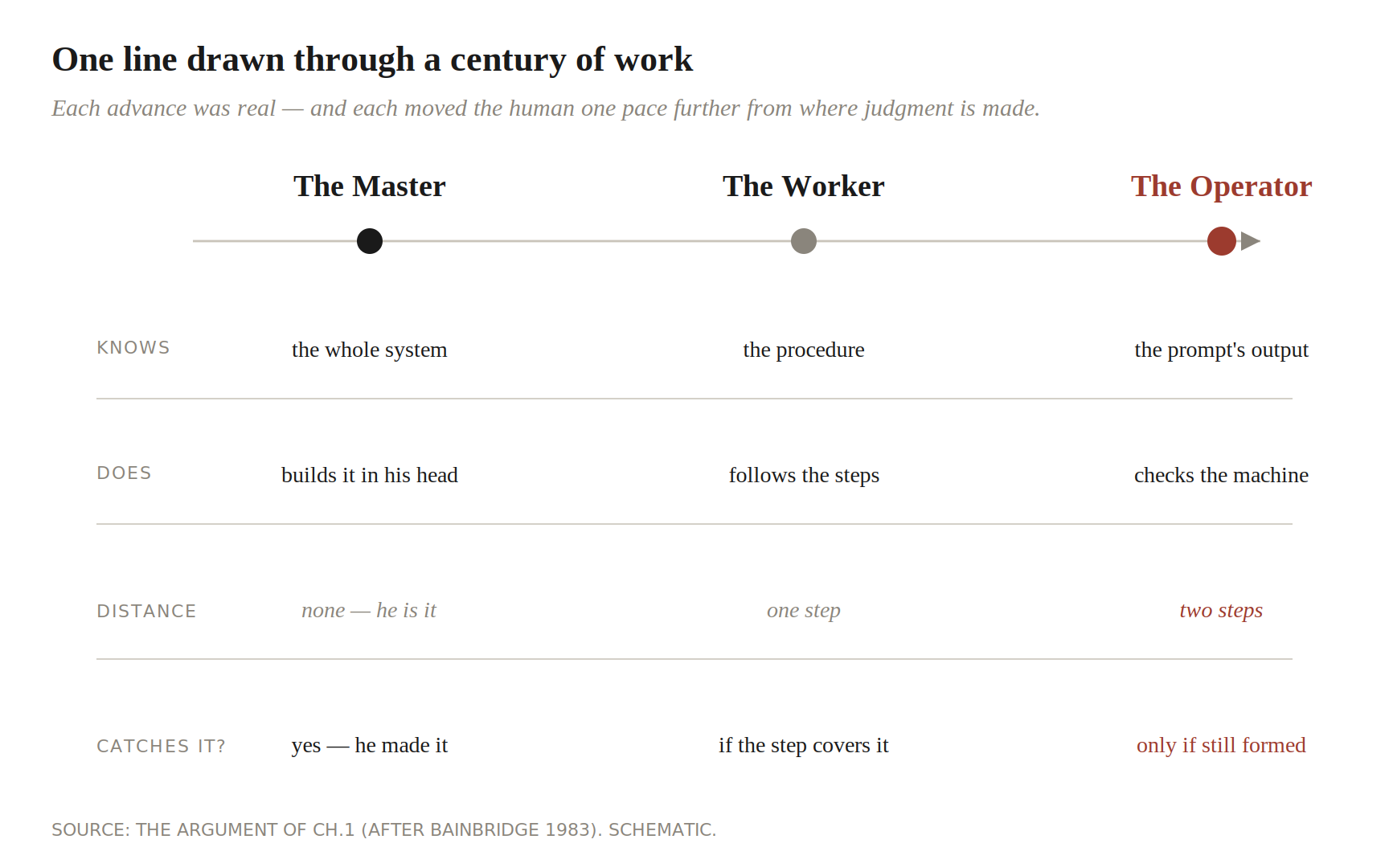
The figure above is the book’s spine: a single line drawn through a century of work. It is worth reading slowly, because each step on it was an advance, and none of them was a mistake.
First the master, who knew the whole system. He built the plant in his head and could run it from memory, because he had made every part of it answer to him. His knowledge died with him unless an apprentice stood beside him long enough to inherit it.
Then the proceduralised worker, who no longer knew the whole system and followed the procedure the master’s knowledge had been distilled into. That was a genuine gain. The knowledge no longer had to be carried whole in one expensive head, and a worker could be trained faster and replaced more easily, which was the point.
And now the operator who supervises a prompt. They do not run the procedure either. They check the output of a machine that ran it, and they are asked to know when that output is wrong without ever having done the work that would have taught them.
Each step moved the human one pace further from the place where judgment is made, and one pace closer to a position where they are held responsible for catching an error they were never given the means to recognise. The distance compounds across the three. The proceduralised worker still touched the work the procedure described. The prompt operator touches only the machine’s account of it.
Gartner has published eight questions a board should ask when it evaluates an AI strategy, organised across four pillars, and it is a good list. They ask whether the investment is competitively positioned and financially sound, whether the systems are performing as intended, whether the organisation has the people and data maturity to scale, and whether the controls sit within appetite. Every one of them takes the machine as the object of oversight.
The line in the figure asks something the list does not reach. Where on it is the person who will have to catch the machine being wrong, and what put them there? That is a question about how work is arranged, which is a thing a board decides and can therefore govern.
None of this turns on the human staying at the controls. A great deal of work now runs faster than any hand could follow, and the judgment going short is the rarer thing: knowing, after the fact and from outside the loop, when the machine has it wrong.
References
- 1The figure is schematic, after Lisanne Bainbridge, “Ironies of Automation,” Automatica, 1983
- 2Gartner, “Questions Boards of Directors Should Ask to Evaluate AI Strategy” — https://www.gartner.com/en/articles/boards-of-directors-and-ai-strategy
The list
Entries arrive weekly. Leave an address and they come to you, along with the publication date when there is one.